

|
|
|
Rotherham |
* Rotherham is in the west Riding of Yorkshire, in the Deanery of Doncaster, in the Archdeaconry of York, and in the diocese and province of York. It is approached by the North Midland Railway, and is only a mile from the Masborough station.
| £. s. d. | |
| Pars abbatis de Clervall | 16 13 4 |
| Vicar ejnsdem partis | 5 0 0 |
| Pars Rogeri cum vicar' ejusdem partis | 21 13 4 |
| Pens. prioris de Lewes | 1 6 8 |
| £. s. d. | |
| The Vicar's stipend, | 16 13 4 |
| Pension to the Dean and Canons of Windsor, | 20 0 0 |
| Pension to the Prior of Lewes, | 1 13 4 |
| Pension to the Archbishop, | 1 6 8 |
| Pension to the Dean and Chapter, | 0 13 4 |
| Synodals, | 0 7 8 |
| Procurations, | 0 5 8 |
| A salary to the Cantarist of Laxion of the grant of John de Lexington, | 3 6 8 |
| Total | £44 6 8 |
| Leaving a clear profit to Rufford of | £23 6 8 |
* It is thus described in "Buckler's Remarks on wayside Chapels:"-
"The chapel at Rotherham approaches nearly in dimensions to that of Wakefield. Their interior admeasurements are respectively 32 ft. by 14 ft., and 40 ft. by 16 ft. 8 in. The design of the chapel at Rotherham is plain: there have been two windows on each side, one at the east end, and one high up, and of small size, at the west end over the entrance. The pediments and side parapets are embattled, and terminated with numerous crocketted pinnacles. The mullions and tracery of all the windows have been destroyed; and whatever ornamental features may have graced the interior, there is nothing of the kind now visible."
| Temp. Instit. | RECTORES. | Patroni. |
| 7Kal.Jan.1229 Robert de Lexington. | Sir William de Vesci and Jeffery Sauresmar. | |
| 1269 John de Selston. | Lady Agnes de Vesci; but in the next year a jury was summoned to try by whatright she presented, who found that she had no right but what her Son John de Vesci might give her. | |
| 4 id. Jan. 1288 | Roger de Blythe. | Collated by the Archbishop, on a lapse. |
| 2 Kal July 1333 | Walter de Wetwang. | The Abbot and Convent of Rufford. |
| 3 id. Dec. 1337 | Richard de Natelby. | He had the King's protection during his attendance on him in France, dated 12 June, 1338. |
| 1 Mar. 1344 | Richard de Castro. | The Abbot and Convent. |
| Temp. Instit. | VICARII. | Patroni. |
| 16 Kal. Jul. 1296 | Eustace de Rotherham. | The Abbots & Brethren of Rufford. |
| 3 Non. Jan.1310 | William de Skyres. | the same |
| 8 id. Maij. 1311 | Laurence de Atwick. | the same |
| William de Liseter. | the same | |
| 24 Oct. 1349 | Regner de Rotherham. | the same |
| Reginald de Clapham. | the same | |
| 17 Dec. 1355 | John, Son of Simon de Fletburgh. | the same |
| 17 Jan. 1392 | Thomas, Son of William de Touton. | the same |
| 14 Feb. 1394 | John Sclater. | the same |
| John Greenfield. | the same | |
| 14 Nov. 1430 | William Morton. | the same |
| 15 Nov. 1441 | Thomas Gilberthorp. | the same |
| 2 Sep. 1444 | William Fox. | the same |
| 22 Oct. 1451 | William Kellen. | the same |
| Ult. Feb. 1467 | Roger Sherwynd. | the same |
| 1478 | John Greenwood. | the same |
| 16 May 1494 | John Kirkall. | the same |
| 18 Dec. 1507 | John Lillie. | the same |
| 17 March 1513 | Richard Hoton, S. T. B. | the same |
| 17 July 1539 | Simon or John Clerkson, S. T. B. | The Earls of Shrewsbury. |
| 13 Oct. 1554 | Nicholas Bramhall. | the same |
| 20 Dec. 1567 | Thomas Corker. | the same |
| 11 Nov. 1577 | Robert Blackwood. | the same |
| 1587 | Thomas Jopson. | the same |
| 23 Oct. 1593 | Thomas Jopson. | the same |
| 10 July 1621 | John Newton. | The Earls of Rotherham. |
| 29 Oct. 1628 | William Dickinson. | the same |
| 17 April 1639 | John Shaw. | the same |
| Luke Clayton. | the same | |
| 7 April 1663 | James Rigby. | Lord Howard of Norfolk. |
| 13 March 1666 | Ellis Farneworth, A.M. | the same |
| 11 March 1670 | Francis Bovil. | the same |
| 15 Aug. 1681 | Henry Moorhouse. | Wm. Smithson, gent., pro hoc vice. |
| 1690 | John Bovile. | Sir Henry, Sir George, and Charles Mawson. |
| 26 Oct. 1697 | Christopher Adam. | George Lord Howard. |
| 16 June 1701 | John Mandevile. | the same |
| 21 July 1704 | Samuel Ferrand. | the same |
| 29 Jan. 1733 | Joseph Eccles. | The Earl of Effingham. |
| 1 Oct. 1734 | John Lloyd. | the same |
| died 12 June 1794 | William Harrison. | the same |
| Thomas Bayliffe. | the same | |
| 1826 | Thomas Blackly. | the same |
| 1842 | Richard Mosley. | the same |
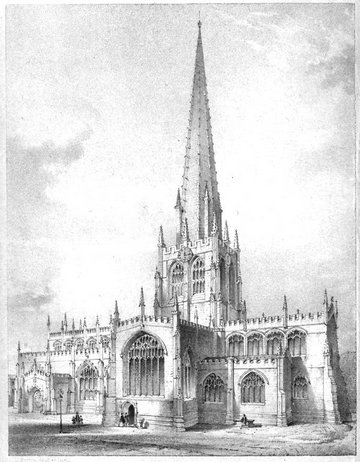 The church is the only object of attraction as you approach the town, but it is of so great beauty that it gives interest even to the murky atmosphere of Rotherham, with the tall black cones of the Masborough forges for a foreground. Truly we may say, " How amiable are thy tabernacles 0 Lord of hosts !" when they can relieve and adorn such a scene as this.
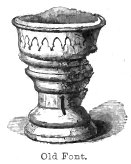 There is a richly moulded door in the south-west corner of the south transept, just outside of which stands an old font, of far better workmanship though much dilapidated, than that which still remains in the Church.
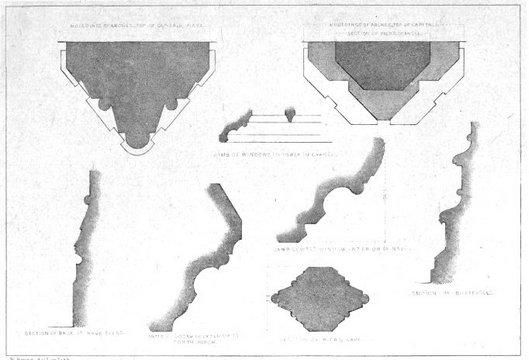
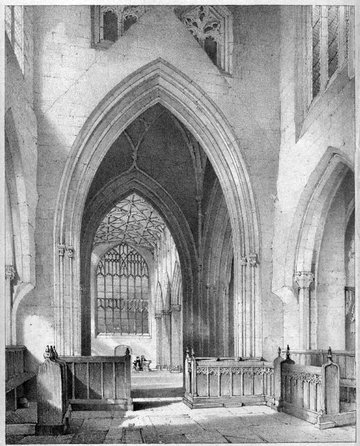 Entering at the south porch we are at once struck by the bold and lofty proportions of the noble nave, which not even the north and south galleries can wholly deprive of its beauty. The nave is of four bays. The piers are of a very singular section, being, in general contour, of an elongated lozenge shape, the longer section running north and south. Something of the same section appears in Ensham Church, Oxfordshire,* but there the longer section is east and west. The effect is, that in Ensham Church, thickness is gained to the piers by longitudinal extension : in Rotherham lightness is gained by latitudinal compression. In each of course the diameter one way is the same as the thickness of the walls; but in Ensham Church one diameter is greater, in Rotherham Church one diameter is less than the thickness of the walls. Ensham gains in solidity, Rotherham in lightness of effect.
* See "A Guide to the Architectural Antiquities of the Neighbourhood of Oxford Part II, Deanery of Woodstock."
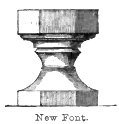 The font stands just within the porch door; a place which has lost its propriety and symbolical meaning by the blocking up that entrance. It is a good substantial octagonal font, but without ornament. It is lined with lead, and is surmounted with a canopy of late work, which has apparently been higher than it now is.
 The nave arch is wide and lofty. Two corbels, one on either side, probably supported the screen.*
* One of the family of Clarel, of Aldwark, bequeathed to the church a cloth of arras, of the passion of our Lord, and his stained cloth of the battle between Lord Scales and the Bastard. The Bastard of Burgundy is meant, who fought with Antony Wedvile, Lord Scales, near Smithfield, King Edward the IV. being present."-Hunter.
* Perhaps it may be worth while to direct the attention of those who may be engaged in the restoration of churches to this particular position as one likely to contain fresco paintings. At Trinity Church, Coventry, a splendid fresco of the last judgment was discovered, also over the nave arch; and in this instance is well preserved. It will perhaps in future be as much the general rule to respect such circumstances of ancient ecclesiastical decorations, as it has been hitherto to destroy them.
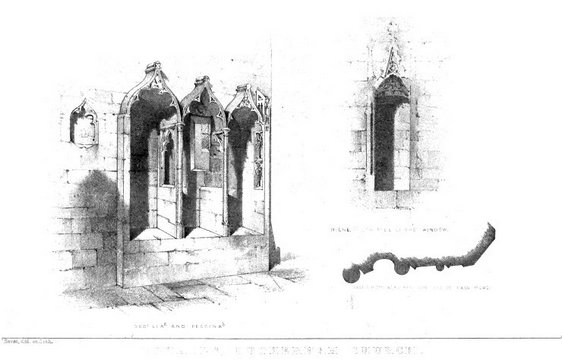
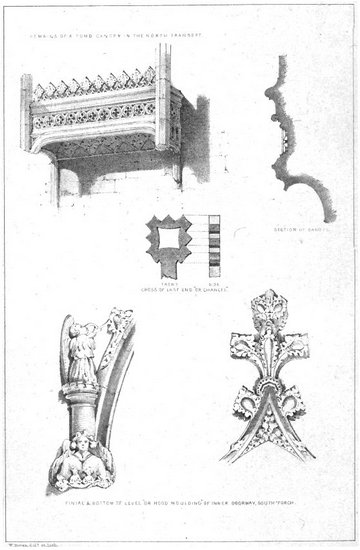
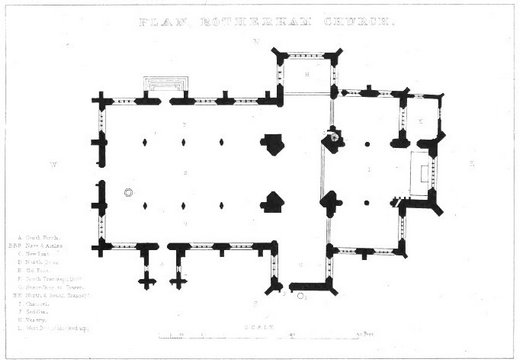 These repairs have certainly been on the whole judicious; and rather than notice with too critical, precision the mistakes that have been made in them, which would be an ungracious task, we will remind those who are interested in this noble fabric, that much still remains to be done. The chancel requires altar furniture, in some degree proportioned to the beauty of the Church: the old frescoes of the nave should be restored; and for harmony as well as splendour of effect, the windows should be filled with stained glass : the great west entrance should be thrown open, and the font furnished with a canopy; and the pulpit, desk, and pews should be lowered, and wood substituted for iron in the rails and desks.* These changes are not to be looked for as the result of one effort; but the people of Rotherham are rich enough, and we would hope pious enough, to work towards such an end as we have described, and if so they will not be long in reaching it.
* Why is a good brass Ecclesiastical Eagle, set aside for a heathen figure of the Bird of Jove, supporting the reading desk?
| Ft. In. | |
| Length of Nave, | 105 0 |
| Width of Nave, | 90 0 |
| Width of North Aisle, | 15 74 |
| Width of South Aisle, | 15 7½ |
| Square of Lantern, | 16 2 |
| Length of Chancel, | 42 0 |
| Total length of the whole Church, | 147 0 |
| Length of North Transept, | 35 2 |
| Length of South Transept, | 35 2 |
| Total length of Transept with Lantern, | 100 5 |
| Width of Chancel, | 23 0 |
| Total width of Chancel with Aisles, | 67 6 |
| Section of Nave piers, (north and south) | 3 3 |
| Section of Nave piers, (east and west), | 2 0 |
| Span of the Arches between Nave and Aisle | 15 2 to 16 2 |
| Span of the Arches between Nave and Aisle, are as follows, from the West-end, | 16 2; 15 2; 15 3; 15 8 |
| Span of Tower Arches, | 16 2 |